Smart Banjar Concept Development: A Qualitative Research
DOI:
https://doi.org/10.58982/krisnadana.v5i2.1041Keywords:
Micro Enterprise; Micro Finance; The Banjar; Smart Concept; Qualitative;Abstract
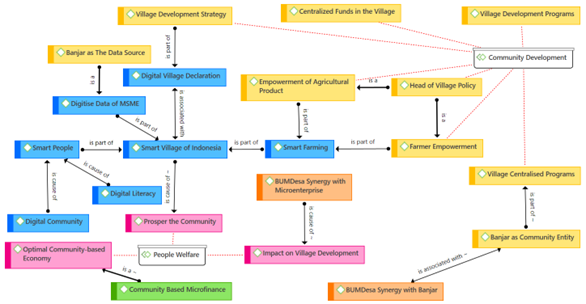
The village and Banjar administrations manage cultural, religious, and socioeconomic activities in Bali. As a result of its customs and heritage, Bali has grown to be a world-famous tourist destination with substantial economic consequences. The influence of Villages and Banjar on tourism growth must benefit the community. The Banjar function must be strengthened to maintain the community's economic resilience by involving financial institutions such as Micro Finance. The synergy between Banjar and Micro Finance can support the development of Micro Enterprises, thereby impacting people's welfare. Based on this, the concept of the Smart Banjar was developed. To conduct qualitative research, interviews were conducted with the Leader of the Village, the Leader of the Banjar, the Leader of Micro Finance, and the Micro Enterprise. The analysis process produces four network diagrams: Micro Enterprise, Micro Finance, Information and Communication Technology Adoption, and Smart Concept. Based on the research results, Banjar, as a community entity, is part of the village-centered program. One existing program is the digitization of Micro Enterprises. It can be done by developing a smart concept that involves community-based Micro Finance. With Micro Finance's involvement as an optimal community-based economy, it can achieve community welfare.
References
I. G. Parimartha, Silang Pandang Desa Adat dan Desa Dinas di Bali. Denpasar: Udayana University Press, 2013.
N. P. Suwardani, W. Paramartha, and I. G. A. Suasthi, “Bale Banjar and Its Implications on The Existence of Bali Sociocultural Communities,” in Proceeding Book International Seminar on Tolerance and Pluralism in Southeast Asia The Faculty Of Religious and Cultural Science, Denpasar: The Faculty of Religious and Cultural Science Universitas Hindu Indonesia, 2018, pp. 83–90.
Gubernur Bali, Bali Provincial Regulation Number 4 Year 2019. Indonesia, 2019.
N. W. Winiasih, P. S. Kurniawan, and G. A. K. R. S. Dewi, “TINJAUAN MENGENAI SANKSI ADAT DALAM KONTEKS PENGELOLAAN KEUANGAN BANJAR ADAT ( Studi Pada Banjar Adat Sesana , Desa Bungaya Kangin , Kecamatan Bebandem, Kabupaten Karangasem, Provinsi Bali),” J. Ilm. Mhs. Akunt., vol. 10, no. 1, pp. 173–183, 2019.
I. W. R. Junaedi, I. W. Damayana, and D. Waruwu, “LPD model and function in increasing the indigeneous Bali economy,” Int. Conf. Fundam. Appl. Res., no. October, pp. 51–62, 2019, [Online]. Available: https://jurnal.undhirabali.ac.id/index.php/icfar/article/view/901
C. Gantini and H. Hanan, “The Impact of Tourism Industry on the Sustainability of Traditional Bale Banjar in Denpasar,” in Proceedings of the 6th International Conference of Arte-Polis, 2017. doi: 10.1007/978-981-10-5481-5.
N. P. A. Sawitri and W. H. Nugrahandika, “Tipologi Perkembangan Pemanfaatan Lahan Bale Banjar dan Faktor-Faktor yang Memengaruhinya Studi Kasus Kota Denpasar, Provinsi Bali,” in Seminar Nasional Space #3, Denpasar: Universitas Hindu Indonesia, 2017, pp. 352–376. [Online]. Available: https://press.unhi.ac.id/2019/01/30/seminar-nasional-space-3/
I. W. Sudemen and N. M. Anggriyani, “Factors Affecting the Development of Customary Village Credit Institution of Sukawana , Kintamani Sub - District , Bangli District,” SINTESA J. Ilmu Sos. dan Ilmu Polit., vol. 8, no. September, pp. 111–118, 2017, [Online]. Available: https://www.ejournal.warmadewa.ac.id/index.php/sintesa
G. Tunio, A. S. Joyo, Z. Lei, N. Channa, and N. Ahmaed, “Performance of Microfinance Providers in Sindh, Pakistan: A Study of Formal and Informal Microfinance Institutes,” IBT J. Bus. Stud., vol. 16, no. 1, pp. 151–170, 2020, doi: 10.46745/ilma.jbs.2020.16.01.11.
A. Abrar, I. Hasan, and R. Kabir, “What makes the difference? Microfinance versus commercial banks,” Borsa Istanbul Rev., 2023, doi: 10.1016/j.bir.2023.03.007.
F. Wang, “An empirical equilibrium model of formal and informal credit markets in developing countries,” Rev. Econ. Dyn., vol. 46, pp. 224–243, 2022, doi: 10.1016/j.red.2021.09.001.
M. Najib and F. Fahma, “Investigating the adoption of digital payment system through an extended technology acceptance model: An insight from the Indonesian small and medium enterprises,” Int. J. Adv. Sci. Eng. Inf. Technol., vol. 10, no. 4, pp. 1702–1708, 2020, doi: 10.18517/ijaseit.10.4.11616.
J. Räisänen and T. Tuovinen, “Digital innovations in rural micro-enterprises,” J. Rural Stud., vol. 73, no. December 2019, pp. 56–67, 2020, doi: 10.1016/j.jrurstud.2019.09.010.
A. A. N. A. Sanjaya and I. N. H. Juliarthana, “Pemanfaatan Bale Banjar Sebagai Ruang Kreativitas Anak Muda Di Kota Denpasar,” J. Sp., vol. 1, no. 1, pp. 26–32, 2019.
J. Hagman, “Qualitative researchers’ experiences of methodological instruction and technology use,” J. Acad. Librariansh., vol. 49, no. 3, p. 102708, 2023, doi: 10.1016/j.acalib.2023.102708.
J. Gelter, M. Fuchs, and M. Lexhagen, “Making sense of smart tourism destinations: A qualitative text analysis from Sweden,” J. Destin. Mark. Manag., vol. 23, no. June 2021, 2022, doi: 10.1016/j.jdmm.2022.100690.
Sugiyono, Metode Penelitian Kualitatif, 3rd ed. Bandung: Alfabeta, 2021.
J. W. Creswell and J. D. Creswell, Research Design Qualitative, Quantitative, and Mixed Methods Approaches, Fifth Edit. SAGE Publications, Inc. All, 2018.
T. Paulus, M. Woods, D. P. Atkins, and R. Macklin, “The discourse of QDAS: reporting practices of ATLAS.ti and NVivo users with implications for best practices,” Int. J. Soc. Res. Methodol., vol. 20, no. 1, pp. 35–47, 2017, doi: 10.1080/13645579.2015.1102454.
G. N. Shava, S. Hleza, F. Tlou, S. Shonhiwa, and E. Mathonsi, “Qualitative Content Analysis, Utility, Usability and Processes in Educational Research,” Int. J. Res. Innov. Soc. Sci., no. October, pp. 2454–6186, 2021, [Online]. Available: www.rsisinternational.org
Z. A. Torabi, M. R. Rezvani, C. M. Hall, and Z. Allam, “On the post-pandemic travel boom: How capacity building and smart tourism technologies in rural areas can help - evidence from Iran,” Technol. Forecast. Soc. Change, vol. 193, no. November 2022, 2023, doi: 10.1016/j.techfore.2023.122633.
I. D. M. A. B. Joni, S. A. Mokhtar, B. A. Talip, and I. P. H. Permana, “Smart Banjar: An ICT Adoption Framework to Enhance People’s Welfare,” Int. J. Adv. Sci. Eng. Inf. Technol., vol. 14, no. 1, pp. 107–117, 2024, doi: 10.18517/ijaseit.14.1.18466.
V. Pathak and S. Deshkar, “Transitions towards Sustainable and Resilient Rural Areas in Revitalising India: A Framework for Localising SDGs at Gram Panchayat Level,” Sustain., vol. 15, no. 9, 2023, doi: 10.3390/su15097536.
K. W. Sandberg and F. Håkansson, “Strategical Use of ICT in Microenterprises: A Case Study,” Int. J. E-entrepreneursh. Innov., vol. 10, no. 1, pp. 1–13, 2020, doi: 10.4018/IJEEI.2020010101.
I. D. M. A. B. Joni, S. A. Mokhtar, and B. A. Talip, “Conceptual Framework of Smart Banjar?: A Synergize of The Micro-enterprise, Microfinance, and The Banjar Institution,” in Advances in Economics, Business and Management Research, 2021, pp. 7–13. doi: 10.2991/aebmr.k.211226.002.
Downloads
Published
Issue
Section
License
Copyright (c) 2026 I Dewa Made Adi Baskara Joni, Bazilah A. Talip, Shamsul Anuar Mokhtar, I Putu Hendika Permana

This work is licensed under a Creative Commons Attribution-NonCommercial-ShareAlike 4.0 International License.