Enhancing ETL Performance in Retail Data Warehousing through Partitioning, Materialization, and Temporary Staging Approaches
DOI:
https://doi.org/10.58982/5nmmd513Keywords:
ETL; Data Warehouse; Partitioned Table; Materialized View; Temporary Table;Abstract
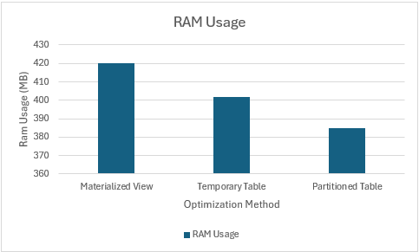
The accelerating accumulation of transactional records across the retail sector has placed considerable pressure on data infrastructures, particularly in supporting time-sensitive business analytics. Within the construction of a retail data warehouse, the Extract, Transform, Load (ETL) stage frequently emerges as the principal performance bottleneck whenever data volume scales upward. The present study seeks to examine and contrast the performance behaviour of three commonly applied ETL optimisation techniques, namely Partitioned Table, Materialized View, and Temporary Table, in order to identify which approach is most appropriate for handling large-volume data integration. To address this objective, an experimental investigation was conducted using five years of accumulated sales transaction data, which were processed through three independent ETL pipelines built in Pentaho Data Integration. Each pipeline was assessed in terms of execution time, CPU utilisation, and RAM consumption. The empirical results reveal that the Partitioned Table approach consistently yields superior performance across every observed metric, achieving the shortest average execution time of 26.4 seconds, the lowest CPU usage at 42 percent, and the smallest memory footprint of 385 MB. These outcomes suggest that segmenting data along temporal attributes provides substantial benefits for ETL workloads, positioning partitioning as the most viable optimisation strategy for retail data warehouse environments. Beyond the technical findings, the study also offers practical guidance for selecting ETL methods that align with data growth trajectories and the constraints of available system resources.
References
[1] M. A. Naeem, F. Mirza, H. U. Khan, D. Sundaram, N. Jamil, and G. Weber, "Big Data Velocity Management–From Stream to Warehouse via High Performance Memory Optimized Index Join," 2020. doi: 10.1109/access.2020.3033464.
[2] B. Khan, W. Khan, S. Jan, and M. I. Chughtai, "An Overview of ETL Techniques, Tools, Processes and Evaluations in Data Warehousing," 2024. doi: 10.32604/jbd.2023.046223.
[3] M. K. S. Uddin and K. M. R. Hossan, "A Review of Implementing AI-Powered Data Warehouse Solutions to Optimize Big Data Management and Utilization," 2024. doi: 10.69593/ajbais.v4i3.92.
[4] A. Qaiser, M. U. Farooq, S. M. N. Mustafa, and N. Abrar, "Comparative Analysis of ETL Tools in Big Data Analytics," 2023. doi: 10.51846/vol6iss1pp7-12.
[5] A. Dhaouadi, K. Bousselmi, M. M. Gammoudi, S. Monnet, and S. Hammoudi, "Data Warehousing Process Modeling From Classical Approaches to New Trends: Main Features and Comparisons," 2022. doi: 10.3390/data7080113.
[6] J. C. Quiroz, T. Chard, Z. Sa, A. Ritchie, L. Jorm, and B. Gallego, "Extract, Transform, Load Framework for the Conversion of Health Databases to OMOP," 2022. doi: 10.1371/journal.pone.0266911.
[7] K. Deepika and M. Tech, "Optimisation of ETL Process Using Partitioning and Parallelization Techniques," Aug. 2017. doi: 10.26483/ijarcs.v8i3.3093.
[8] G. Dijerja, R. Soepriadi, and S. Samidi, "Analisis Perbandingan Response Time View dan Materialized View pada Database Oracle dalam Treasury Big Data DJPb Kemenkeu," Jurnal Pendidikan dan Teknologi Indonesia, vol. 5, no. 2, pp. 393–402, Feb. 2025, doi: 10.52436/1.JPTI.671.
[9] D. Seenivasan, "Improving the Performance of the ETL Jobs," International Journal of Computer Trends and Technology, vol. 71, pp. 27–33, Aug. 2023, doi: 10.14445/22312803/IJCTT-V71I3P105.
[10] E. Saputra, "Permodelan Data Warehouse Untuk Penjualan Ban Menggunakan Online Analytical Processing (OLAP)," 2023. doi: 10.58602/jima-ilkom.v2i1.13.
[11] R. A. Ghani and R. Kurniawan, "Implementasi Extract, Transform, Load Process Pada Perancangan Data Warehouse Terkait Kualitas Pendidikan Di Kabupaten Serang," 2024. doi: 10.36040/jati.v8i2.9081.
[12] R. Y. Irawan, B. Susanto, and Y. Lukito, "Building Data Warehouse and Dashboard of Church Congregation Data," 2021. doi: 10.21460/jutei.2019.32.183.
[13] V. Shendryk, Y. Parfenenko, O. Boiko, S. Shendryk, and Y. Bielka, "Aggregation of Multidimensional Data for the Decision Support Process for the Management of Microgrids With Renewable Energy Sources," 2022. doi: 10.15587/2706-5448.2022.255957.
[14] D. J. C. Sihombing, "Academic Data Warehouse Modeling in Higher Education Using Nine-Step Design Methodology," 2022. doi: 10.51519/journalisi.v4i4.399.
[15] M. D. Syaputra, A. Nazir, S. K. Gusti, S. Sanjaya, and F. Syafria, "Data Warehouse Design for Sales Transactions on CV. Sumber Tirta Anugerah," 2022. doi: 10.24014/coreit.v8i2.19800.
[16] L. Sautot, S. Bimonte, and L. Journaux, "A Semi-Automatic Design Methodology for (Big) Data Warehouse Transforming Facts Into Dimensions," 2021. doi: 10.1109/tkde.2019.2925621.
[17] D. Tan, J. Wiratama, and S. F. Wijaya, "Sales Analysis on Garment Industry With Datawarehouse and ETL Implementation on Star Schema," 2024. doi: 10.33022/ijcs.v13i1.3770.
[18] F. Z. D. Wardhani and J. Wiratama, "Improving the Quality of Service: ETL Implementation on Data Warehouse at Pharmacy Industry," 2024. doi: 10.33365/jtk.v18i1.3211.
[19] P. Bednarczuk, "Optimization in Very Large Databases by Partitioning Tables," 2020. doi: 10.35784/iapgos.2056.
[20] D. S. Budi and H. Syahrial, "Pengoptimalan Performa Database Pada Proses Transformasi Data Pada SQL Server," 2023. doi: 10.33050/tmj.v8i3.2167.
[21] E. Y. Gueddoudj and A. Chikh, "Towards a Scalable and Efficient ETL," 2023. doi: 10.12785/ijcds/140195.
[22] E. Y. Gueddoudj, A. Chikh, and A. Attia, "Os-ETL: A High-Efficiency, Open-Scala Solution for Integrating Heterogeneous Data in Large-Scale Data Warehousing," Ingenierie des Systemes d'Information, vol. 28, no. 3, pp. 557–565, Jun. 2023, doi: 10.18280/ISI.280303.
Downloads
Published
Issue
Section
License
Copyright (c) 2026 I Putu Susila Handika, I Kadek Susila Satwika

This work is licensed under a Creative Commons Attribution-NonCommercial-ShareAlike 4.0 International License.