Inventory Forecasting System Using LSTM for Vape Store
DOI:
https://doi.org/10.58982/krisnadana.v5i1.981Keywords:
Stock Forecasting, Long Short-Term Memory (LSTM), Vape Store, Inventory Management, Web-Based SystemAbstract
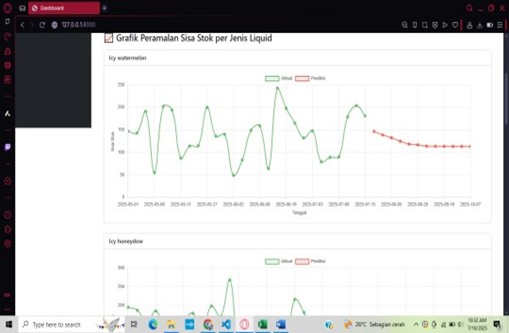
Inventory management remains a critical challenge for small and medium-sized retail businesses, including Gonvapestore, a vape retailer in Bali, where stock decisions are often made intuitively. This study aims to design and implement a stock forecasting system using the Long Short-Term Memory (LSTM) algorithm to enhance the accuracy of monthly inventory predictions. The research follows the Knowledge Discovery in Database (KDD) process, encompassing data selection, preprocessing, and time series transformation through a sliding window approach. The LSTM model was developed using TensorFlow and Keras, and its forecasting accuracy was evaluated using Root Mean Square Error (RMSE), Mean Absolute Error (MAE), and Mean Absolute Percentage Error (MAPE) metrics. Experimental results show that the LSTM model achieved superior performance compared to ARIMA, with RMSE and MAE values of 3.14 and 2.71, respectively, versus 6.05 and 5.21 for ARIMA. Product-level evaluation using MAPE indicates that Icy Lychee achieved a relatively low error rate of 37%, while Icy Mango (50%) and Icy Watermelon (52%) exhibited higher error rates, suggesting model performance may vary across product categories. These results demonstrate the LSTM model’s superior ability to capture nonlinear sales patterns compared to traditional statistical approaches. The model was integrated into a Django-based web system with a real-time visualization dashboard and sales logging features. The proposed system offers a practical and intelligent decision-support tool for retail inventory management, reducing stockout and overstock risks through data-driven forecasting.
References
R. Gunawan, Y. Suherman, et al., “Perancangan Sistem Informasi Pengadaan Barang Berbasis Web Pada PT. Sintas Kurama Perdana Karawang,” Jurnal Ilmiah Ekonomi dan Bisnis, vol. 14, no. 1, pp. 101–113, 2021. [Online]. Available: http://journal.stekom.ac.id/index.php/E-Bisnis
A. Hajjah and Y. N. Marlim, “Analisis Error Terhadap Peramalan Data Penjualan,” Techno.Com, vol. 20, no. 1, pp. 1–9, 2021. [Online]. Available: https://doi.org/10.33633/tc.v20i1.4054
H. A. Hurtado-Mora, A. H. García-Ruiz, et al., “Sales Forecasting with LSTM, Custom Loss Function, and Hyperparameter Optimization: A Case Study,” Applied Sciences (Switzerland), vol. 14, no. 21, 2024. [Online]. Available: https://doi.org/10.3390/app14219957
Q. Ma, “Comparison of ARIMA, ANN and LSTM for Stock Price Prediction,” E3S Web of Conferences, vol. 218, pp. 1–5, 2020. [Online]. Available: https://doi.org/10.1051/e3sconf/20202180102 6
A. S. Millah, Apriyani, et al., “Analisis Data dalam Penelitian Tindakan Kelas,” Jurnal Kreativitas Mahasiswa, vol. 1, no. 2, pp. 140– 153, 2023.
A. S. Pasaribu and A. R. Nasution, “Pengaruh Perdagangan Internasional terhadap Pertumbuhan Ekonomi di Indonesia,” Eksis: Jurnal Ilmiah Ekonomi dan Bisnis, vol. 15, no. 1, p. 22, 2024. [Online]. Available: https://doi.org/10.33087/eksis.v15i1.426
A. Rolangon, A. Weku, et al., “Perbandingan Algoritma LSTM Untuk Analisis Sentimen Pengguna Twitter Terhadap Layanan Rumah Sakit Saat Pandemi Covid-19,” TeIKa, vol. 13, no. 1, pp. 31–40, 2023. [Online]. Available: https://doi.org/10.36342/teika.v13i01.3063
D. Susilo, A. Chusyairi, et al., “Prediksi Penjualan Untuk Optimasi Stock Produk Menggunakan Algoritma Long Short Term Memory,” Sistematis: Jurnal Ilmiah Sistem Informasi, vol. 1, no. 2, pp. 119–134, 2025. [Online]. Available: https://doi.org/10.69533/56gyat30
I. Kurniawan, I. H. Santi, et al., “Sistem Informasi Geografi Pemetaan Lokasi Tanah Letter C Desa Menggunakan Mapbox Berbasis Web,” Jurnal Teknologi dan Sistem Informasi, vol. 7, pp. 232–242, 2024.
A. Kurniawati, M. S. Ahmad, et al., “Analisis Perbandingan Metode Time Series Forecasting Untuk Prediksi Penjualan Obat Di Apotek (Studi Kasus: Kimia Farma Apotek Takoma),” Jurnal Jaringan dan Teknologi Informasi, vol. 3, no. 1, pp. 96–106, 2023. [Online]. Available: https://doi.org/00.0000/jati
D. Setiadi, B. Irawan, et al., “Penerapan Algoritma K-Means Clustering Pada Pembesaran,” Jurnal Teknik Informatika, vol. 7, no. 6, pp. 3320–3327, 2023.
G. Tamami and M. Arifin, “Penggunaan LSTM dalam Membangun Prediksi Penjualan untuk Aplikasi Laptop Lens,” Jurnal Informatika, vol. 14, no. 2, pp. 301–308, 2024.
M. T. Tombeng and Z. Ardian, “Supermarket Sales Prediction Using Deep Learning Approach,” CogITo Smart Journal, vol. 7, no. 1, pp. 160–169, 2021.
K. Umam, “Perbandingan Metode ARIMA dan LSTM pada Prediksi Jumlah Pengunjung Perpustakaan,” Journal MIND, vol. 8, no. 2, pp. 119–129, 2023. [Online]. Available: https://doi.org/10.26760/mindjournal.v8i2.119 -129
F. Yanti, B. Nurina Sari, et al., “Implementasi Algoritma LSTM Pada Peramalan Stok Obat (Studi Kasus: Puskesmas Beber),” Jurnal Mahasiswa Teknik Informatika, vol. 8, no. 4, pp. 6082–6089, 2024.
R. Zubaedah, J. Budiasto, et al., “Implementasi Customer Relationship Management (CRM) pada Toko Young Bucks Vape Store Berbasis Android,” Musamus Journal of Technology & Information (MJTI), vol. 6, no. 1, pp. 5–10, 2023.
Downloads
Published
Issue
Section
License
Copyright (c) 2025 I Putu Agus Eka Darma Udayana, Ni Putu Suci Meinarni , I Gusti Ayu Agung Randhika Kerlania, I Putu Utama Arta, I Made Adi Sutrisna

This work is licensed under a Creative Commons Attribution-NonCommercial-ShareAlike 4.0 International License.