Integrating WebQual 4.0 and Machine Learning for Evaluating JDIH Tabanan Regency Website
DOI:
https://doi.org/10.58982/pfefaf94Keywords:
WebQual 4.0; sentiment analysis; Random Forest; E-Government; Machine Learning;Abstract
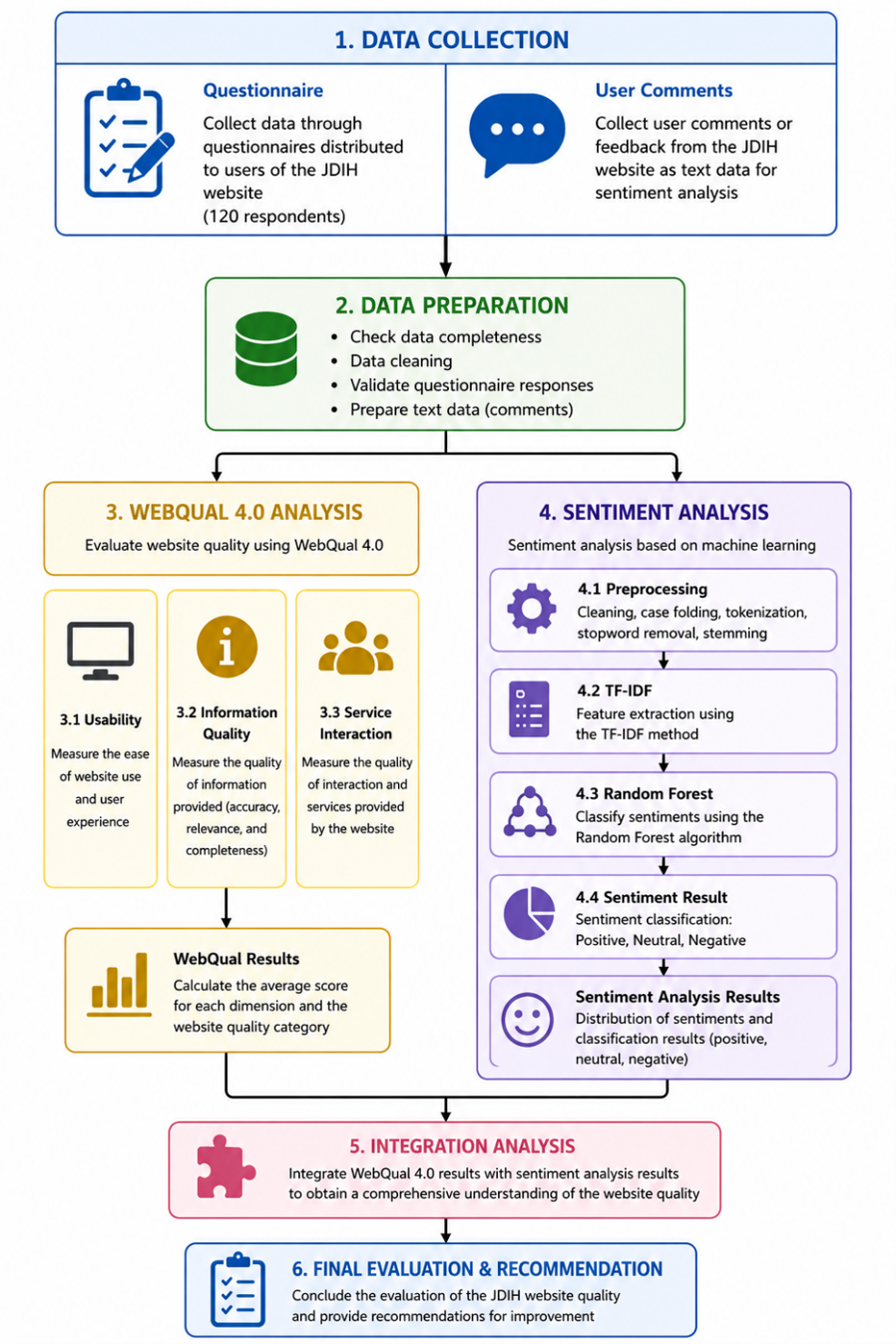
The Legal Documentation and Information Network (JDIH) website of Tabanan Regency is a digital public service platform that provides access to regional regulations and legal documents. Evaluating website quality is important to ensure that the services provided are able to meet user needs and expectations. Previous studies on website evaluation generally applied either WebQual 4.0 or sentiment analysis separately, while studies integrating both approaches remain relatively limited. Therefore, this study combines WebQual 4.0 and machine learning–based sentiment analysis to provide a more comprehensive website evaluation. This study employed a mixed-methods approach involving 120 respondents and 120 user comments. Website quality evaluation was conducted using the WebQual 4.0 framework through three dimensions: usability, information quality, and service interaction. Sentiment analysis was performed using preprocessing techniques, TF-IDF feature extraction, and the Random Forest algorithm. The results showed that all WebQual dimensions achieved excellent categories, with usability obtaining the highest mean score of 4.487. Positive sentiment dominated user comments at 59.2%, while the Random Forest model achieved an accuracy rate of 79%. This integrated approach provided a more comprehensive evaluation and identified several technical aspects that still require improvement, including system performance, feature optimization, and interface consistency.
References
[1] A. D. Putri, R. Mahendra, and S. Wijaya, “Analisis kualitas website menggunakan WebQual 4.0 pada layanan publik,” Jurnal Sistem Informasi, vol. 12, no. 1, pp. 45–55, 2025.
[2] K. Huda, M. F. Rahman, and A. Prasetyo, “Website quality evaluation using WebQual 4.0 method,” International Journal of Information Systems, vol. 10, no. 2, pp. 120–130, 2025.
[3] L. Rachmayani, D. Purnama, and Y. Saputra, “Website quality analysis using WebQual approach,” Jurnal Teknologi Informasi, vol. 9, no. 1, pp. 33–42, 2025.
[4] E. Meidika, N. Kurniawan, and R. Aditya, “Evaluation of government website quality using WebQual,” Journal of E-Government Studies, vol. 8, no. 2, pp. 88–98, 2024.
[5] D. H. Pamungkas and Subhan, “Analysis of website quality using WebQual and IPA method,” Jurnal Informatika, vol. 11, no. 1, pp. 67–75, 2023.
[6] E. D. Yang, H. Lee, and J. Kim, “WebQual evaluation in e-learning systems,” International Journal of Education Technology, vol. 7, no. 2, pp. 50–60, 2024.
[7] W. Murdoko, “Website evaluation using WebQual method,” Jurnal Sistem Komputer, vol. 6, no. 1, pp. 22–30, 2023.
[8] A. K. Wijayanti, F. Nugroho, and I. Saputri, “E-government website evaluation using WebQual,” Journal of Digital Government, vol. 5, no. 2, pp. 77–85, 2024.
[9] W. Kusumawardhana, “Literature review of WebQual method,” Jurnal Teknologi dan Informasi, vol. 13, no. 1, pp. 10–20, 2025.
[10] M. A. Nurrahman, “User satisfaction analysis using WebQual 4.0,” Jurnal Sistem Informasi, vol. 14, no. 1, pp. 55–65, 2025.
[11] M. T. Tusar and M. T. Islam, “Sentiment analysis using machine learning techniques,” International Journal of Computer Applications, vol. 174, no. 5, pp. 15–22, 2021.
[12] J. Devlin, M. Chang, K. Lee, and K. Toutanova, “BERT: Pre-training of deep bidirectional transformers for language understanding,” in Proceedings of the NAACL-HLT Conference, Minneapolis, MN, USA, 2019, pp. 4171–4186.
[13] Y. Goldberg, Neural Network Methods in Natural Language Processing. Cambridge, U.K.: Cambridge University Press, 2022.
[14] S. Bird, E. Klein, and E. Loper, Natural Language Processing with Python. Sebastopol, CA, USA: O’Reilly Media, 2021.
[15] T. Mikolov, K. Chen, G. Corrado, and J. Dean, “Efficient estimation of word representations in vector space,” arXiv preprint arXiv:1301.3781, 2021.
[16] J. Han, M. Kamber, and J. Pei, Data Mining: Concepts and Techniques, 4th ed. Burlington, MA, USA: Morgan Kaufmann, 2021.
[17] I. Goodfellow, Y. Bengio, and A. Courville, Deep Learning. Cambridge, MA, USA: MIT Press, 2022.
[18] C. D. Manning, P. Raghavan, and H. Schütze, Introduction to Information Retrieval. Cambridge, U.K.: Cambridge University Press, 2021.
[19] A. Géron, Hands-On Machine Learning with Scikit-Learn, Keras, and TensorFlow, 3rd ed. Sebastopol, CA, USA: O’Reilly Media, 2022.
[20] T. Hastie, R. Tibshirani, and J. Friedman, The Elements of Statistical Learning, 2nd ed. New York, NY, USA: Springer, 2021.
[21] K. P. Murphy, Machine Learning: A Probabilistic Perspective. Cambridge, MA, USA: MIT Press, 2022.
[22] B. Liu, Sentiment Analysis and Opinion Mining. San Rafael, CA, USA: Morgan & Claypool Publishers, 2021.
[23] S. Russell and P. Norvig, Artificial Intelligence: A Modern Approach, 4th ed. Hoboken, NJ, USA: Pearson, 2021.
[24] F. Chollet, Deep Learning with Python, 2nd ed. Shelter Island, NY, USA: Manning Publications, 2022.
[25] J. Brownlee, Machine Learning Mastery with Python. Melbourne, Australia: Machine Learning Mastery, 2023.
[26] Sugiyono, Metode Penelitian Kuantitatif, Kualitatif, dan R&D. Bandung, Indonesia: Alfabeta, 2022.
Downloads
Published
Issue
Section
License
Copyright (c) 2026 Gusti Putu Sutrisna Wibawa, Putu Sugiartawan, Ni Wayan Sumartini Saraswati

This work is licensed under a Creative Commons Attribution-NonCommercial-ShareAlike 4.0 International License.