Adaptive User Interfaces: A Systematic Literature Review
DOI:
https://doi.org/10.58982/6msy0m84Keywords:
Adaptive Interface; User Experience; Machine Learning; HCI; PRISMA.Abstract
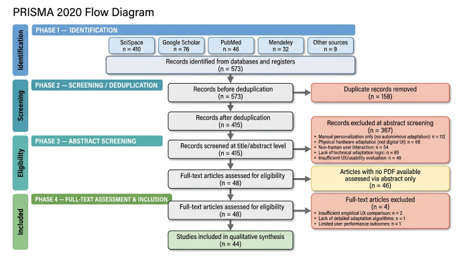
Adaptive User Interfaces (AUIs) dynamically adjust interface elements based on user behavior, context, and preferences to enhance usability and performance. This systematic literature review, conducted following PRISMA 2020 guidelines, synthesizes evidence from 44 studies across five major academic databases. The review examines methodologies, adaptation techniques, implementation platforms, and the impact of AUIs on user experience. Results demonstrate that machine learning—particularly reinforcement learning and deep learning—dominates adaptation techniques and consistently yields superior task performance (6.67–27.3% improvement over static interfaces). Mobile applications and web interfaces are the most prevalent deployment platforms. Key challenges include predictability, privacy, cognitive load management, and user autonomy. Future research should prioritize explainable AI integration, standardized evaluation frameworks, and longitudinal studies.
References
[1] N. Lavie and Y. Gothelf, "Adaptive user interfaces in modern web applications," Int. J. Human-Computer Studies, vol. 164, 2022, doi: 10.1016/j.ijhcs.2022.102832.
[2] F. Brudy et al., "Cross-device taxonomy: survey, opportunities and challenges of interactions spanning across multiple devices," Proc. CHI, 2019, doi: 10.1145/3290605.3300792.
[3] D. Browne, M. Norman, and E. Adhami, "Why build adaptive systems?," in Adaptive User Interfaces, Academic Press, London, 1990.
[4] T. Sherman William, "SAUCI. Self-Adaptive User Computer Interfaces," 1986.
[5] P. Langley, "User modelling in adaptive interfaces," Proc. UM'99, 1999.
[6] D. Browne, M. Norman, and E. Adhami, "Adaptive user interfaces: Principles and practice," Academic Press, 1990.
[7] M. Selma, A. Naveed, and L. Mohammed, "Adaptive user interface design and analysis using emotion recognition," PLOS ONE, 2020, doi: 10.1371/JOURNAL.PONE.0235908.
[8] D. A. Vasilev and A. Ayesh, "Mobile user interface adaptation based on usability reward model and multi-agent reinforcement learning," Multimodal Technol. Interact., vol. 8, no. 4, 2024, doi: 10.3390/mti8040026.
[9] Wang, "Adaptive fusion of multi-cultural visual elements using deep learning in cross-cultural visual communication design," Sci. Rep., 2025, doi: 10.1038/s41598-025-13386-5.
[10] Beauchemin et al., "EEG-based passive BCI system adapts learning speed to cognitive load in real-time," Front. Human Neurosci., 2024, doi: 10.3389/fnhum.2024.1416683.
[11] M. Riaz, "Intelligent Front-End Personalization: AI-Driven UI Adaptation," Proc. ACDSA 2026, doi: 10.1109/ACDSA67686.2026.11467738.
[12] P. Langley, "An adaptive system that discovers user interface preferences," Adaptive User Interfaces, 1990.
[13] G. Krzysztof Z. et al., "Predictability and accuracy in adaptive user interfaces," Proc. CHI, 2008, doi: 10.1145/1357054.1357252.
[14] M. Selma et al., "Privacy in adaptive systems," PLOS ONE, 2020.
[15] Q. Qing-Xing et al., "Reducing UI complexity using use case analysis," CMC-Comput. Mater. Continua, 2025, doi: 10.32604/cmc.2025.069245.
[16] M. J. Page et al., "The PRISMA 2020 statement: an updated guideline for reporting systematic reviews," BMJ, vol. 372, 2021, doi: 10.1136/bmj.n71.
[17] N. V. and C. A., "Adaptive User Interface Optimization Using a Cognitive-Load-Aware Double Q-Learning Framework," IEEE Access, 2026, doi: 10.1109/ACCESS.2026.11522154.
[18] Ewing, Fairclough, and Gilleade, "Evaluation of an adaptive game using EEG measures validated during the design process as inputs to a biocybernetic loop," Front. Human Neurosci., 2016, doi: 10.3389/fnhum.2016.00223.
[19] Beauchemin et al., "Enhancing learning experiences: EEG-based passive BCI," Front. Human Neurosci., 2024, doi: 10.3389/fnhum.2024.1416683.
[20] D. Ramos-Bernárdez et al., "An Adaptive Industrial Human-Machine Interface to Optimise Operators Working Performance," Proc. AIM, 2021, doi: 10.1109/AIM46487.2021.9517434.
[21] G. A., G. M., and P. JI., "Adaptive GUI Customizations to Enhance User Experience," Int. J. Human-Computer Interaction, 2026, doi: 10.1080/10447318.2026.2623542.
[22] Rizzoglio et al., "Building an adaptive interface via unsupervised tracking of latent manifolds," Neural Networks, 2021, doi: 10.1016/j.neunet.2021.01.009.
[23] L. Findlater and J. McGrenere, "A comparison of static, adaptive, and adaptable menus," Proc. CHI, 2004, doi: 10.1145/985692.985704.
[24] A. Cockburn et al., "Predictability and accuracy in adaptive interfaces," Proc. CHI, 2007.
[25] L. Findlater and J. McGrenere, "Beyond performance: Feature awareness in personalized interfaces," Int. J. Human-Computer Studies, 2010, doi: 10.1016/J.IJHCS.2009.10.002.
[26] D. Martin and E. Zdenek, "Fine-grained adaptive UI for personalization of a word processor," Proc. HCII, 2011, doi: 10.1007/978-3-642-22098-2_99.
[27] T. Theophanis, "Towards the systematic assessment and design of adaptive user interfaces," Ph.D. dissertation, University of Cyprus, 2007.
[28] B. Kevin B. et al., "A theoretical analysis and preliminary investigation of dynamically adaptive interfaces," Int. J. Aviation Psychol., 2001, doi: 10.1207/S15327108IJAP1102_04.
[29] L. Nunes and R. Munoz-Saavedra, "Investigating UI displacements in an adaptive mobile homescreen," Int. J. Mobile HCI, 2016, doi: 10.4018/IJMHCI.2016070101.OA.
[30] K. Z. Gajos et al., "Automatically generating personalized user interfaces with SUPPLE," Proc. IUI, 2004, doi: 10.1145/1012709.1012728.
Downloads
Published
Issue
Section
License
Copyright (c) 2026 I Gusti Ngurah Darma Paramartha, Md. Wira Putra Dananjaya, Adie Wahyudi Okatavia Gama, Gusi Putu Lestara Permana

This work is licensed under a Creative Commons Attribution-NonCommercial-ShareAlike 4.0 International License.