AI-Based Model for Predicting On-Time Graduation of INSTIKI Students Using K-NN and Particle Swarm Optimization
DOI:
https://doi.org/10.58982/krisnadana.v5i1.930Keywords:
K-Nearest Neighbor (K-NN), Particle Swarm Optimization (PSO), Academic performance prediction, educational data mining, Artificial IntelligenceAbstract
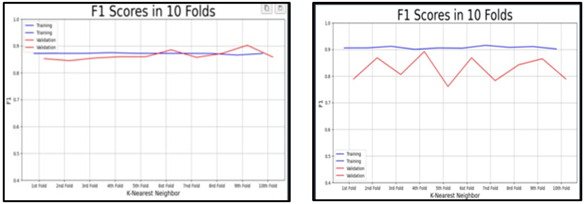
This study aims to enhance the accuracy and generalization capability of student on-time graduation prediction by integrating the K-Nearest Neighbor (K-NN) algorithm with Particle Swarm Optimization (PSO) for parameter tuning. Historical academic records from INSTIKI were used as the primary dataset, and a 10-fold cross-validation technique was applied to ensure robust evaluation. The PSO algorithm was employed to determine the optimal k value for K-NN, with optimization parameters set to c1 = 0.5, c2 = 0.6, inertia weight w = 0.9, swarm size = 90 particles, and 100 maximum iterations. The optimized model achieved an optimal k = 23, resulting in a validation accuracy of 77.84%, outperforming the baseline K-NN’s 72.43%. In addition, improvements were observed in precision, recall, F1-score, and AUC, with the latter increasing from 0.56 to 0.68, indicating better discrimination capability. These results demonstrate that PSO effectively mitigates overfitting and enhances model stability compared to conventional K-NN. The proposed approach offers a reliable and scalable predictive model for academic early-warning systems, enabling institutions to identify at-risk students earlier and implement targeted interventions. Future work may involve incorporating non-academic features, addressing class imbalance, and exploring ensemble learning for further performance gains.
References
S. Sharma and P. Singh, “Enhanced K-Nearest Neighbor classification using Particle Swarm Optimization,” Expert Systems with Applications, vol. 202, p. 117103, Jan. 2022.
M. K. Hasan et al., “Student academic performance prediction model using machine learning algorithms,” IEEE Access, vol. 9, pp. 78333–78348, 2021.
Y. Zhang, J. Li, and H. Wang, “Hybrid optimization of KNN parameters using swarm intelligence,” Applied Soft Computing, vol. 113, p. 107946, Dec. 2021.
N. S. Arum, F. Pradana, and A. F. Rahman, “Academic performance prediction using ensemble learning,” Indonesian Journal of Electrical Engineering and Computer Science, vol. 25, no. 1, pp. 448–455, Jan. 2022.
M. S. Ahmad, S. Z. M. Hashim, and W. Ismail, “Improved PSO-based feature selection for educational data mining,” IEEE Access, vol. 10, pp. 59324–59336, 2022.
D. Zhang et al., “Optimization of machine learning classifiers for student performance prediction,” Computers & Education: Artificial Intelligence, vol. 3, p. 100049, 2022.
A. A. Rahman and T. M. Mahmoud, “Comparative analysis of classification algorithms for academic risk prediction,” Procedia Computer Science, vol. 203, pp. 515–522, 2022.
H. Kaur and A. Sharma, “PSO-based optimization for KNN in high-dimensional datasets,” Neural Computing and Applications, vol. 34, no. 14, pp. 11315–11330, July 2022.
P. Li et al., “Swarm intelligence in education data analytics: A case study,” Applied Intelligence, vol. 52, no. 11, pp. 12594–12610, Nov. 2022.
J. T. Lamba and R. S. Sandhu, “Machine learning-based early warning systems for higher education,” Education and Information Technologies, vol. 27, pp. 12341–12359, 2022.
F. S. Al-Anzi and E. AbuZeina, “Using optimization techniques to improve classification accuracy for educational datasets,” Journal of King Saud University - Computer and Information Sciences, vol. 34, no. 9, pp. 6388–6399, Oct. 2022.
S. H. Lee et al., “Application of swarm intelligence in predictive analytics for academic data,” IEEE Transactions on Learning Technologies, vol. 15, no. 6, pp. 845–858, Dec. 2022.
R. P. Mohanty et al., “PSO tuned KNN for student dropout prediction,” IEEE Access, vol. 10, pp. 98765–98774, 2022.
J. B. Silva et al., “Machine learning for academic success prediction: A comparative study,” Education and Information Technologies, vol. 27, pp. 11425–11442, 2022.
A. S. Rahman et al., “Predicting student performance using hybrid machine learning models,” Expert Systems, vol. 39, no. 8, p. e12951, Aug. 2022.
Y. Liu et al., “Parameter optimization in KNN using metaheuristic algorithms,” Engineering Applications of Artificial Intelligence, vol. 115, p. 105319, 2022.
T. Hastie, R. Tibshirani, and J. Friedman, The Elements of Statistical Learning: Data Mining, Inference, and Prediction, 2nd ed. New York, NY, USA: Springer, 2021.
I. Goodfellow, Y. Bengio, and A. Courville, Deep Learning. Cambridge, MA, USA: MIT Press, 2019.
C. M. Bishop, Pattern Recognition and Machine Learning. Cham, Switzerland: Springer, 2020.
S. Russell and P. Norvig, Artificial Intelligence: A Modern Approach, 4th ed. Upper Saddle River, NJ, USA: Pearson, 2021.
M. W. Setiawan and F. A. Bachtiar, “Implementasi algoritma KNN untuk prediksi kelulusan mahasiswa,” in Proc. 6th National Seminar on Information Technology, Surabaya, Indonesia, 2021, pp. 45–50.
A. Budiarto, R. T. Handoko, and S. P. Nugroho, “Optimization of KNN using PSO for educational data,” in Proc. IEEE International Conference on Information Technology Systems and Innovation (ICITSI), Bandung, Indonesia, 2020, pp. 1–6.
R. A. Putri, “Penerapan metode KNN untuk prediksi kelulusan mahasiswa,” Undergraduate Thesis, Informatics Dept., Universitas Negeri Yogyakarta, Yogyakarta, Indonesia, 2020.
Pusat Data dan Teknologi Informasi Pendidikan, “Statistik pendidikan tinggi Indonesia,” Kementerian Pendidikan, Kebudayaan, Riset, dan Teknologi Republik Indonesia. [Online]. Available: https://pddikti.kemdikbud.go.id. [Accessed: Aug. 5, 2024].
World Bank, “Education Statistics – All Indicators,” World Bank Data. [Online]. Available: https://data.worldbank.org/indicator. [Accessed: Aug. 5, 2024].
Ministry of Education and Culture, Republic of Indonesia, “Peraturan Menteri Pendidikan dan Kebudayaan Nomor 3 Tahun 2020 tentang Standar Nasional Pendidikan Tinggi,” Jakarta, Indonesia: Kemdikbud, 2020.
Downloads
Published
Issue
Section
License
Copyright (c) 2025 Made Leo Radhitya, I Made Dwi Asana, Ni Luh De Sri Chandra Purahita, I Made Subrata Sandhiyasa, I Nyoman Tri Anindia Putra

This work is licensed under a Creative Commons Attribution-NonCommercial-ShareAlike 4.0 International License.